
Particle size testing quantifies particle size, distribution, and shape to control material behavior and guarantee quality across incoming inspection, formulation, and scale-up. It reports metrics like D10/D50/D90, surface area Particle Size Distribution testing, volume fractions, and counts within size ranges. Methods include sieving, laser diffraction, dynamic light scattering, sedimentation, and image analysis. Results guide specifications, sampling, and process adjustments to maintain performance, stability, and regulatory compliance. Further details explain method selection, data interpretation, and practical next steps.

What Particle Size Testing Measures and When to Test
When does particle size testing matter and what does it quantify? The practice measures distribution, mean diameter, and shape-related metrics across populations of particles. It quantifies surface area, volume fractions, and counts within specified size ranges, using techniques like sieving Lab Alliance, laser diffraction, and microscopy.
Testing matters at stages where material consistency, process control, regulatory compliance, or batch release depend on reproducible granular properties. It is applied during incoming inspection, formulation development, scale-up, and when changes in suppliers or processes occur.
Results inform specification limits and sampling strategies without prescribing downstream performance choices. Laboratories report statistical descriptors, uncertainty, and method parameters so stakeholders can decide interventions aligned with their priorities for autonomy and control over material attributes.
How Particle Size Affects Product Performance
How does particle size influence a product’s behavior across manufacturing, stability, and end-use performance? Particle size governs flowability, packing density, and ease of mixing, affecting throughput and processing flexibility.
Surface area-to-volume ratios change reaction rates, dissolution, and bioavailability, so smaller particles speed actions while larger ones prolong release.
Stability links to aggregation, sedimentation, and chemical reactivity: inconsistent distributions yield phase separation or uneven potency.
Optical and tactile properties—color, opacity, texture—depend on size, shaping consumer perception.
Filtration, coating, and spray characteristics are size-sensitive, influencing application and waste.
Controlling particle size enables targeted functionality and efficient resource use, granting formulators freedom to tune performance while reducing rework, rejects, and regulatory risks through predictable, reproducible outcomes.
Common Particle Size Measurement Methods Explained
Because particle size underpins critical attributes such as dissolution, flow, and appearance, selecting an appropriate measurement method is essential for reliable characterization across development and production.
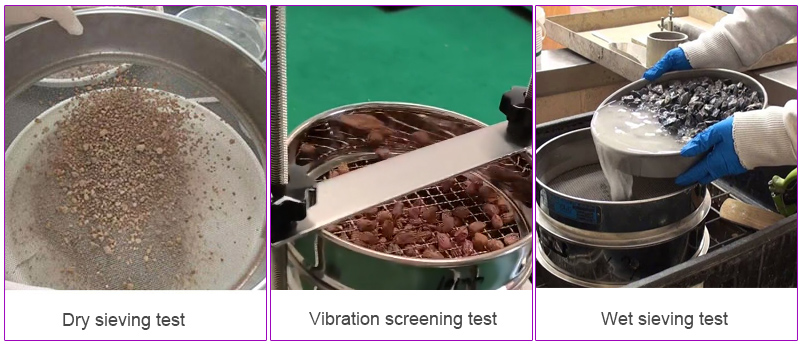
Common techniques include laser diffraction for broad size distributions, offering rapid, statistically robust data suitable for powders and suspensions; dynamic light scattering for submicron and colloidal systems, sensitive to Brownian motion; sieving for coarse granular materials, simple and reproducible when particle shapes allow; image analysis for morphology and size together, providing visual confirmation and digital metrics; and sedimentation methods for density-influenced separations.
Each method brings trade-offs in range, resolution, sample preparation, and throughput. Practitioners favor methods aligning with product form and testing goals while maintaining flexibility to verify results across orthogonal techniques.
Choosing the Right Particle Size Test
Which measurement best answers the question at hand depends on material attributes, regulatory needs, and intended use. Selection balances resolution, throughput, sample state, and cost. The aim is practical: choose a method that liberates product development without unnecessary constraints.
- Laser diffraction suits broad distributions and rapid testing, ideal when speed and repeatability support innovation.
- Dynamic light scattering works for submicron colloids when sensitivity to small sizes is critical and samples remain stable.
- Imaging and sieving offer morphological detail or coarse fractionation when particle shape or bulk behavior drives performance.
Decision-makers prioritize methods that match tolerances and workflows, enabling flexible experimentation while satisfying compliance and manufacturing realities.
Interpreting Particle Size Data and Next Steps
Once a measurement technique is selected, interpreting the resulting distributions and planning follow-up actions becomes the priority. The practitioner examines central tendencies (D10, D50, D90), span, and polydispersity to assess conformity with specifications and functional needs.
Comparisons to historical batches reveal drift or shifts; overlaying cumulative curves highlights subtle changes. Outliers prompt verification: check sample prep, instrument calibration, and data processing parameters.
When adjustments are required, choose targeted interventions—modify milling parameters, change sieving protocols, or reformulate suspensions—then re-test to confirm effects.
Reporting should be transparent, documenting methods, assumptions, and uncertainty estimates to enable replication. Decisions balance performance, cost, and regulatory constraints, preserving flexibility while ensuring product quality and reproducible freedom in process control.
Conclusion
Particle size testing quantifies the distribution, mean, and range of particle dimensions within a material, informing formulation, processing, and quality control decisions. Regular testing is critical when particle-dependent attributes—dissolution, stability, flowability, optical properties or reactivity—affect performance. Selecting an appropriate method and correctly interpreting results enables troubleshooting, regulatory compliance, and product optimization. Ultimately, consistent particle size characterization diminishes variability, supports scale-up, and guarantees that finished products meet intended specifications and end‑user expectations.


